
Picture this. Your customer pays in December. The money lands, the night ends, and everyone goes home happy. Then, weeks later, a notice arrives: the customer’s bank has reversed the payment, and the money is already out of your account.
Nigerian business owners started describing this publicly after the 2024 season. In January 2025, Eche Emole (@Echecrates) wrote that the post-December spending hangover ends in disputes, as the rent comes due and the bank statements arrive.

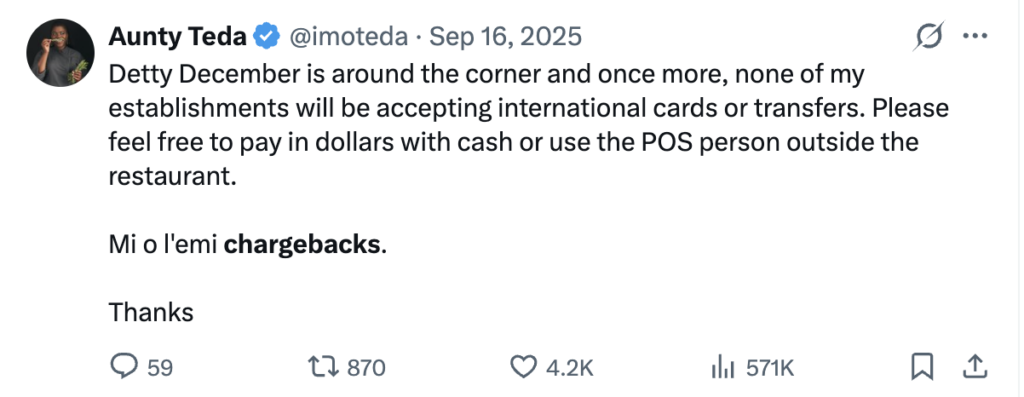
In September 2025, restaurant owner Aunty Teda (@imoteda) announced that none of her establishments would accept international cards or transfers that December. The post passed 570,000 views.
The Rapport’s “Detty December Shakedown” followed the story through the 2025 season: diaspora visitors partied in Lagos and reversed payments when they got home, and vendors began turning foreign cards away.
Whatever the motive behind a given dispute, a regret, a misunderstanding or outright fraud, the merchant is left with the same result. This guide covers how that happens, why refusing foreign cards doesn’t fully solve it, and how Tender can give Nigerian businesses another way to accept payments from international customers before the rush starts.
Quick answer: Nigerian businesses can prepare for Detty December by adding a payment method that international customers can use and that can’t be reversed after the fact. With Tender, businesses can accept crypto payments from customers, receive the payment in their Tender wallet, and withdraw in naira or another supported currency. The customer sends from their own wallet, and the payment is final once confirmed. Set up in October or early November, because KYC, testing and staff training all take time. A checklist is at the end of this post.
Why does Q4 bring a different customer mix?
From late November, the people spending in Lagos change. Alongside your regular customers you get returning Nigerians (the “IJGB” crowd), foreign visitors, event attendees and even people paying on behalf of family at home. Reports cited by Leadership say tens of thousands of Nigerians return every December, and that Lagos State’s tourism ministry treats December as the city’s highest tourism revenue window.
Their spending lands in specific places: restaurants, club tables, hotel add-ons, event tickets, beauty services and retail. Those are high-ticket, high-volume, often card-present transactions where nobody has time for verification. That is also where disputes concentrate.
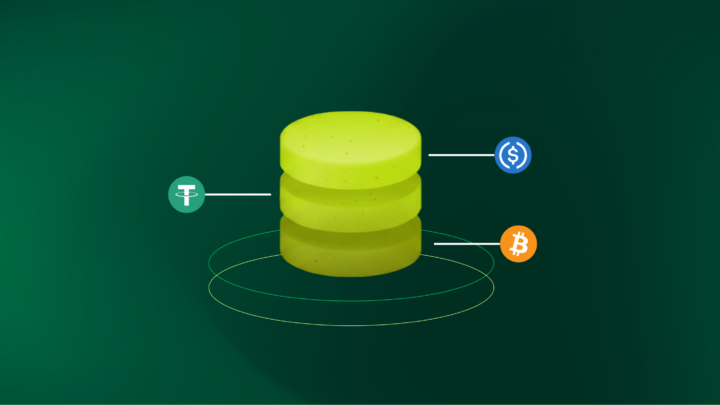
For businesses expecting more international customers, having more than one way to get paid matters. Tender gives merchants an additional payment option for customers who already use crypto, particularly stablecoins such as USDT and USDC. That means a customer doesn’t have to rely solely on an international card to pay you.
What does a chargeback do to a Nigerian merchant?
A chargeback is a dispute the cardholder files with their own bank, not with you. It exists to protect people from real card fraud, and it does that job. The problem is how it works when the card was issued abroad:
- The reversal comes first, and your response comes after. The funds leave your account while you gather evidence.
- Cross-border disputes take longer and demand more proof. Innovation Village’s analysis notes that evidence thresholds are higher for international disputes and that merchants often lack the documentation card networks expect.
- Your usual evidence may not be enough. The Rapport points out that the screenshots, receipts and delivery confirmations many Nigerian merchants hold often fall short of what international card networks require.
- Disputes carry their own costs. One published analysis puts dispute fees at roughly ₦5,000 to ₦20,000 per case, on top of the reversed amount.
- The scale is global. The Rapport cites a Mastercard estimate that businesses worldwide could lose around $15 billion in 2025 to fraudulent and disputed chargebacks.
Not every dispute is dishonest, and that is part of the difficulty. A process built to protect cardholders will always favour the cardholder, and the merchant is left proving a sale that already happened.
This is where an alternative payment method can help. Tender doesn’t replace cards, but it gives businesses another way to accept payment when a customer would rather pay with crypto.
Is refusing foreign cards the answer?
It protects you from one risk, but it has a cost. International customers tend to spend more, and refusing their cards means refusing your best December revenue or pushing it elsewhere. Aunty Teda’s own announcement shows where it goes: cash dollars, or a POS agent outside the door.
Those routes have their own problems. Cash dollars mean exchange-rate decisions, counting, security and reconciliation. A POS agent puts a third party between you and your customer, with fees and delays you don’t control. Neither gives you a clean record of the sale.
What businesses actually need is a third option: a payment method that international customers can use, that settles quickly, and that doesn’t have the same card chargeback mechanism. That’s one of the problems Tender is built to solve.
How do crypto payments change the risk?
With a crypto payment gateway, such as Tender, the customer sends payment from their own wallet. Three things follow:
- The payment is final once confirmed. There is no issuing bank in the middle, so no card dispute process can pull the funds back.
- Refunds are your decision. You set the policy and handle it directly with the customer.
- Every payment leaves a record. Each transaction has a timestamp, an amount and a transaction hash on the blockchain.
The cost is predictable. Tender charges 2% per transaction, capped at $100. On a $1,500 bar tab, that is $30. A reversed card payment for the same bill costs you $1,500 plus the dispute fee.
Crypto does not fix everything, and it helps to be clear about that:
- Your customer has to hold crypto. Many do. Nigeria ranked 6th globally in Chainalysis’s 2025 Global Crypto Adoption Index (see what the 2026 data shows), but not every customer will. Offer crypto alongside your existing options, not instead of them.
- You still need a refund policy. Finality protects you from reversals, so write down how you’ll handle genuine complaints.
- Staff must wait for confirmation. A customer’s screenshot is not a confirmed payment.
Nigerian law doesn’t prohibit businesses from accepting crypto; what’s regulated is who provides crypto services. Our guide on whether it’s legal to accept crypto payments in Nigeria covers it in detail.
Why shouldn’t you wait until December to set up?
December is the worst time to learn a new payment flow. Working back from the first week of December:
| When | What to do |
|---|---|
| October | Choose your payment channel. Create your Tender account and complete KYC (approval takes about 24 hours). Request POS hardware if you need it. |
| Early November | Set up your outlet(s). Run a test payment from start to withdrawal. Train staff. |
| Mid-November | Tell your customers. Put it on your Instagram, your menu, your checkout and your front desk. |
| First week of December | Go live, and review the first few days of transactions. |
Customers can’t pay in crypto if they don’t know you accept it. A sign at the till and a line in your bio will do more than any setup tweak. If you’re new to this, how to start accepting cryptocurrency in your business walks through the basics.
Online, POS or WhatsApp: which should you use?
Tender calls each way of accepting payments an Outlet, and you can run more than one.
| Your business | Best Outlet | How it works |
|---|---|---|
| Online store or platform | Online Outlet | Install the WooCommerce plugin or integrate via API. “Pay with crypto” appears at checkout. The customer picks a chain and coin, receives a wallet address and QR code for the exact amount, and has 30 minutes to pay. |
| Restaurant, bar, hotel, shop, event stall | In-Person Outlet (POS) | The customer picks a chain and token, then scans the QR code or taps an NFC-enabled phone on the device. Confirmation takes between one minute and two hours depending on the chain. |
| Sellers who close deals in DMs or people who don’t want additional hardware | Social Payments (WhatsApp) | You message the Tender bot, enter the amount in naira, choose the chain and token, and share the QR card it generates. Your customer doesn’t need WhatsApp and you don’t need a website. |
What happens to the money? Stablecoins and settlement
You don’t have to hold crypto. Payments land in your Tender wallet, and you choose how to withdraw: as fiat (naira or any of 16+ settlement currencies, with USD for the rest) to your bank account, or as crypto to your own wallet. With Auto-Payout, withdrawals happen automatically on the schedule you set.
Customers can pay in any of 300+ crypto assets across 20+ blockchains, and stablecoins like USDT and USDC are the simplest for pricing because they track the dollar. Your customer pays the amount you quoted, and you aren’t exposed to price swings between payment and withdrawal. For a deeper look, see how crypto payment settlement actually works and our guide to accepting USDT and getting paid in naira.
How do you prepare your team?
Most December payment problems come from staff, not software. Before the rush:
- Walk every person who takes payments through one full transaction, from the customer’s choice of chain to confirmation.
- Agree on what “paid” means. Staff wait for confirmation on the device or dashboard, never a screenshot.
- Write a one-line script for explaining the option to customers: “You can pay in crypto: scan this or tap your phone.”
- Name one person for exceptions, such as wrong-network sends, underpayments and refund requests.
- Write your refund policy down and make sure staff know it.
- Keep your transaction records. Reconcile daily during December so nothing piles up for January.
Q4 crypto payments checklist
- [ ] Decide which Outlet(s) fit your business: online, POS, Social Payments
- [ ] Create your Tender account and complete KYC (allow at least 24 hours)
- [ ] Set up your Outlet(s), and request your POS device now if you need one
- [ ] Choose how you’ll withdraw: naira or other fiat, crypto, or Auto-Payout
- [ ] Run a test payment from start to withdrawal
- [ ] Train every staff member who takes payments
- [ ] Assign one person to handle exceptions
- [ ] Write and share your refund policy
- [ ] Announce crypto payments to customers before December starts
- [ ] Reconcile daily and review your first week of transactions
Frequently asked questions
Can Nigerian businesses accept crypto payments?
Yes. Businesses can accept crypto through a payment gateway, which handles the crypto side so you can be paid in naira or another currency. See our legality guide for detail.
Can a customer reverse a crypto payment?
No. A confirmed on-chain payment can’t be pulled back by a bank or card network. Refunds are handled by you, the merchant.
Do I need to hold or understand crypto to accept it?
No. You can withdraw every payment as fiat to your bank account, or set up Auto-Payout so it happens automatically.
What if my customer doesn’t have crypto?
Then they pay another way. Crypto works best as an additional option for customers who already hold stablecoins, including many international customers.
How long does setup take?
KYC approval takes about 24 hours. After that, most merchants can create an Outlet and run a test payment quickly. POS devices are shipped on request, so order early.
December will bring your biggest customers of the year. Make sure the money stays yours. Create your Tender account and be ready before the first international customer walks in.
Read more from Tender:
- How Nigerian Businesses Can Prepare for Crypto Payments This Detty December
- Crypto Payment Gateway in Nigeria: Accept Crypto and Settle in Naira
- USDT Payment Gateway in Nigeria: Accept USDT and Get Paid in Naira
- Crypto Adoption in Nigeria and Africa: What the 2026 Data Actually Shows
- How to Choose a Crypto Payment Gateway: 5 Things to Check Before You Sign Up