Quick answer: A USDT payment gateway lets a Nigerian business accept USDT (a US dollar-pegged stablecoin) from customers, and automatically converts it into Naira on receipt. The business never has to hold crypto, understand blockchain, or track a price… they just get paid in the currency they already use.
USDT solves a specific problem for Nigerian merchants: customers who want to pay in crypto, international or diaspora buyers who don’t have easy access to Naira transfers, and businesses that want protection from card chargebacks and currency volatility. This page covers how it actually works to accept USDT and get paid in Naira.
What Is a USDT Payment Gateway?
A USDT payment gateway is infrastructure that sits between a crypto-paying customer and a business’s bank account. The customer sends USDT (a stablecoin pegged 1:1 to the US dollar) and the gateway handles the conversion and payment into the business’s local currency, in this case Naira.
The business doesn’t need a crypto wallet they manage themselves, doesn’t need to watch exchange rates, and doesn’t need any prior crypto experience. From their side, it functions like any other payment method: a customer pays, the business gets settled.
Why Nigerian Businesses Accept USDT
There isn’t one single reason. It depends on the business, but a few come up consistently.
Protection from chargeback fraud. This is one of the strongest drivers, particularly for merchants who see a spike in international card transactions — for example, retail and hospitality businesses during the December travel season, when diaspora visitors pay by card and later dispute the charge after they’ve returned abroad. Crypto payments settle on-chain and are final. There’s no chargeback mechanism to exploit.
Stability during the transfer. USDT is pegged to the dollar, so its value doesn’t move while a payment is in transit — unlike a volatile crypto asset, where the amount received could differ from the amount sent depending on price swings during the payment window.
Protection from Naira volatility. Because USDT tracks the dollar rather than the Naira, a business that chooses to hold funds in USDT rather than convert immediately is shielded from Naira depreciation over time. Businesses can decide when to convert.
Lower cost than cross-border alternatives. International wire transfers and remittance channels typically carry high fees and multi-day delays. USDT settles directly, without a chain of correspondent banks.
Access to customers banks can’t reach. Diaspora buyers, international clients, and crypto-holding customers can pay directly, without needing a Nigerian bank account or dealing with wire transfer restrictions.
Reduced cash handling risk. For physical retail, accepting a digital payment method — crypto or otherwise — reduces the operational risk that comes with handling cash.
What is Tender
Tender is a crypto payment gateway that allows businesses to get paid in stablecoins like USDT and other cryptocurrencies while getting settled in your local currency. We support 15+ currencies, so you don’t have to deal with the crypto you’re paid in.

USDT vs. Bank Transfer
| USDT Payment | Bank Transfer (International) | |
|---|---|---|
| Settlement time | Instant | 3–7 business days |
| Fees | 2% per transaction, capped at $100 | Typically 2–5% in FX and wire fees |
| Availability | 24/7, including weekends | Banking hours only |
| Reversibility | Final, cannot be reversed | Can be delayed, recalled, or blocked |
| Access | Anyone with a crypto wallet | Requires banking relationships on both ends |
For a domestic NIP transfer, speed isn’t usually the issue. The issue is when the payer’s bank is outside Nigeria and has to move money through international banking rails.
USDT vs. International Cards
| USDT Payment | International Card Payment | |
|---|---|---|
| Chargeback risk | None — payments are final | Present, and a common source of fraud |
| Card decline issues | Not applicable | Common with foreign-issued cards |
| FX/interchange fees | 2%, capped at $100 | Often 3–5%+, plus currency conversion markups |
| Customer requirement | A crypto wallet | A card that works internationally and isn’t blocked |
Card payments carry a structural risk that USDT doesn’t: a customer can dispute a card charge with their bank weeks after the transaction, and the merchant can lose both the goods and the money. A confirmed USDT payment can’t be disputed or reversed.
Which Networks Can Customers Use
Customers can send USDT on major networks, including Tron, Ethereum, BNB Smart Chain, Solana, and others supported by Tender. The customer selects the specific network and token before making the payment, whether they’re paying online, via WhatsApp, or in person — which is what keeps the transaction accurate (more on this below).
How the Payment Works
The flow is consistent across all three ways a business can accept crypto with Tender; Online, WhatsApp, or In-Person:
- The customer chooses to pay with crypto
- They select the network and token they’re sending from (for example, USDT on Tron)
- They’re shown the exact crypto amount due, along with a wallet address and QR code
- They send the payment from their own wallet, or tap an NFC-enabled phone at a POS device
- The payment window is 30 minutes
- Once confirmed on-chain, settlement to the merchant’s Tender wallet is instant
How Settlement Works
Settlement happens in two stages.
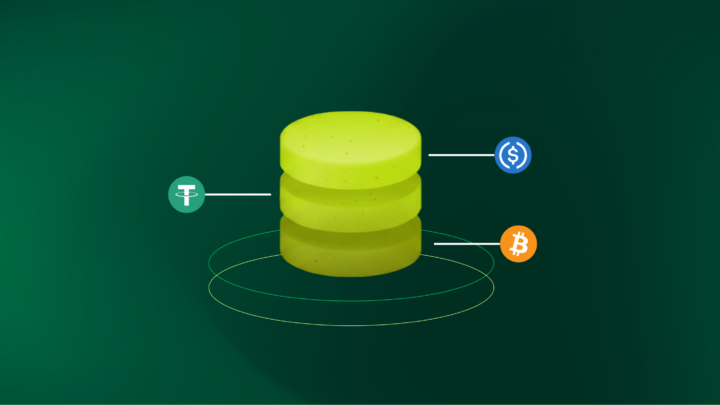
Stage 1: Receive. Every incoming payment lands in the business’s Tender wallet, broken down by asset (USDT, USDC, BTC, and others). The business can see the full balance and its Naira value at any time.
Stage 2: Withdraw. The business chooses how to move funds out:
- Fiat Payout — select Naira, select the bank, and funds are converted and sent to the business’s account
- Crypto Payout — send funds to a crypto wallet of the business’s choosing, if they’d rather hold value in USDT
Businesses can also set up Auto-Payout, so funds are withdrawn automatically —instantly, daily, weekly, or monthly — without needing to trigger a manual withdrawal each time.
How Much Tender Charges
Tender charges 2% per transaction, capped at $100 meaning even on very large transactions, the fee never exceeds $100. This applies to receiving, sending, and swapping funds on the platform.
There are also small, one-time network activation fees on certain chains: $0.50 on Tron, $0.50 on Stellar, and $3.00 on XRPL. Most networks have no activation fee. There is a minimum conversion amount of roughly $10 USD equivalent.
How Quickly Merchants Receive Funds
Once a customer’s payment is confirmed on-chain, it lands in the merchant’s Tender wallet instantly. From there, a fiat payout to a Nigerian bank account is also instant. There’s no multi-day withdrawal delay on either side of the transaction.
What Happens If a Customer Sends the Wrong Network
This isn’t something merchants need to plan around, because the payment flow is built to prevent it. Before any payment is made, the customer specifies exactly which network their USDT is on:
- Online checkout: the customer selects the network and token directly from a dropdown before the wallet address and QR code are generated
- In-Person (POS): the cashier enters the specific network the customer states they’re paying from
- WhatsApp: the customer selects the network from a list before the payment QR code is issued
Because the correct network is confirmed before any funds move, sending USDT on the wrong network isn’t something that happens in practice.
How Refunds Work
Crypto payments are final. Once a transaction is confirmed on-chain, it cannot be reversed. This is a deliberate part of how the system works, and it’s what protects merchants from chargeback fraud in the first place.
Tender doesn’t process refunds. If a merchant wants to refund a customer for any reason, that refund has to be handled directly between the merchant and the customer, outside the platform.
How to Integrate
Online store (Shopify or WooCommerce): Install the Tender plugin, set up an Online Outlet in the dashboard, and add the API key. No developer required. Custom API integration is available for other platforms.
WhatsApp: Create a WhatsApp Outlet from your dashboard. Message the Tender Bot to start receiving payments. From there, the business’s WhatsApp becomes a functioning point of sale — payments can be initiated and transaction history reviewed directly in the chat.
In-Person (POS): Request a POS device from the dashboard. It ships globally and supports both QR code and NFC tap-to-pay.
In all three cases, setup starts with KYC verification, which typically takes about 24 hours to approve.
FAQs
What is USDT?
USDT (Tether) is a stablecoin; a type of cryptocurrency designed to hold a stable value, pegged 1:1 to the US dollar. Unlike Bitcoin or Ethereum, its value doesn’t fluctuate significantly.
Is it legal for a Nigerian business to accept USDT?
Accepting crypto payments in Nigeria isn’t illegal. Regulatory frameworks around crypto in Nigeria have continued to develop, and a compliant payment gateway handles the KYC/AML verification required to operate within them. A business doesn’t need to obtain its own separate crypto license to accept payments through a platform like Tender. Read more here.
Do I need to understand crypto to accept USDT payments?
No. The customer sends crypto; the business receives Naira (or another supported currency). Tender handles the conversion in between.
Can I choose not to hold crypto at all?
Yes. Set up an automatic fiat payout, and funds convert to Naira and land in your bank account without any manual step.
Is there a minimum transaction amount?
Yes; approximately $10 USD equivalent per conversion.
What happens if a customer overpays?
Overpayments are handled automatically within the system’s tolerance threshold and reflected in the merchant’s balance.
Can I accept USDT if I only sell through WhatsApp or Instagram, with no website?
Yes; the WhatsApp Outlet is built exactly for this. No website or storefront is required.
Read More from Tender
- How Nigerian Businesses Can Prepare for Crypto Payments This Detty December
- Crypto Payment Gateway in Nigeria: Accept Crypto and Settle in Naira
- USDT Payment Gateway in Nigeria: Accept USDT and Get Paid in Naira
- Crypto Adoption in Nigeria and Africa: What the 2026 Data Actually Shows
- How to Choose a Crypto Payment Gateway: 5 Things to Check Before You Sign Up