

Quick answer:
A crypto payment gateway lets a Nigerian business accept cryptocurrency from any customer, anywhere, and receive the value in Naira.
The customer pays in the crypto they hold, and the business never has to touch crypto directly unless they choose to.
What Is Tender?
Tender is a Nigerian crypto payment infrastructure company that enables businesses to accept cryptocurrency and stablecoin payments and settle in local currency. Merchants can accept over 300 crypto assets across 20+ blockchains — including USDT, USDC, Bitcoin, and Ethereum — through three ways of selling: an Online Outlet for Shopify and WooCommerce stores, a WhatsApp Outlet for businesses that sell through chat, and an In-Person Outlet for physical locations, including NFC tap-to-pay.
Settlement isn’t limited to Naira. Tender supports payout in 16+ local currencies, with USD available for any currency not yet on the list, which means the same infrastructure works for a merchant serving customers in Lagos and one serving customers across several countries at once.
Tender also functions as more than a payment processor. Businesses can hold funds as crypto their wallet rather than converting it immediately, giving them the option to decide when to cash out.
How a Crypto Payment Gateway Works
The process is the same regardless of which crypto a customer sends:
- Customer pays: They select a payment method, choose the network and asset they’re sending (for example, USDT on Tron, or Bitcoin), and send the payment to a generated wallet address or QR code.
- Tender confirms the payment: The transaction is verified on-chain. Confirmation time depends on the network. Most confirm within minutes, some can take up to two hours.
- The crypto is converted: Once confirmed, the value is converted from crypto into Naira at the current rate.
- The merchant receives Naira: They can withdraw funds instantly to a Nigerian bank account, or hold it in the wallet as crypto if the merchant prefers.
This flow is identical whether the customer pays through an online store, a WhatsApp chat, or a POS device in person. Only the interface changes.
Which Cryptocurrencies Tender Supports
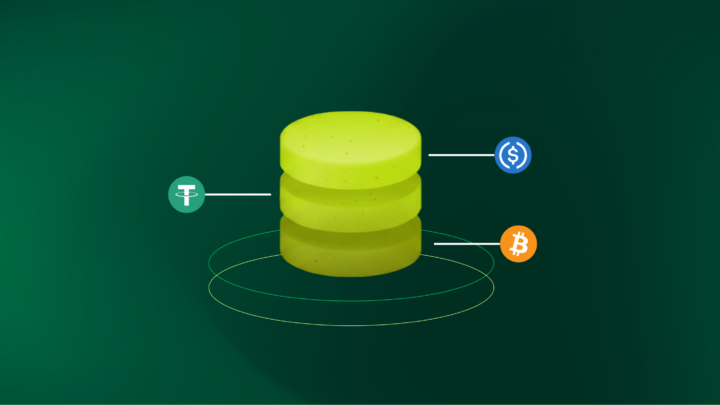
Tender supports over 300 crypto assets across 20+ blockchains, but a handful come up most often in practice:
USDT (Tether): a stablecoin pegged to the US dollar. This is the most commonly used asset for merchant payments, because its value doesn’t move during the transaction. [See the full breakdown of accepting USDT payments in Nigeria →]
USDC (USD Coin): another dollar-pegged stablecoin, functionally similar to USDT, and available across the same core outlets.
BTC (Bitcoin): supported for merchants who want to accept payment from Bitcoin holders directly, with the same instant-confirmation-to-Naira settlement.
ETH (Ethereum): supported both as a native asset and as the network for a wide range of other tokens.
Beyond these, Tender supports payment across networks including Solana, BNB Smart Chain, Polygon, Avalanche C-Chain, TRON, Stellar, TON, XRPL, Optimism, and Movement. In practice, most Nigerian merchants default to stablecoins like USDT or USDC specifically because the settlement amount is predictable. However, the option to accept a broader range of assets is there for merchants whose customers hold them.
Why Nigerian Businesses Use Crypto Payments
The reasons vary by business type, but they tend to cluster around a few specific situations.
International customers: A customer outside Nigeria who wants to pay a Nigerian business often runs into the same wall: their card doesn’t work, or a bank transfer takes days and loses value to FX fees along the way. Crypto payments bypass that entirely. The customer pays directly, and the merchant is settled in Naira without waiting on a cross-border banking chain.
Diaspora customers: Nigerians abroad frequently want to pay for goods, services, or gifts for family back home. Traditional remittance channels are slow and carry fees on both ends. A diaspora customer holding USDT or another crypto asset can pay a Nigerian business directly, in minutes.
Cross-border commerce: Any business exporting goods, invoicing international clients, or working with vendors and partners abroad deals with the same friction. Correspondent banking delays, FX exposure, and payment methods that don’t translate across borders. Crypto payments remove several of those steps at once.
Digital services: Freelancers, consultants, and service providers who bill international clients often face the highest friction of all. International wire fees can eat a disproportionate share of a smaller invoice. A crypto payment gateway gives them a direct, low-fee way to get paid without needing an international bank account.
E-commerce: Online stores lose sales at checkout when a customer’s preferred payment method isn’t available, particularly international or crypto-holding customers. Adding crypto as a checkout option, through Shopify or WooCommerce, captures that demand without disrupting the existing store setup.
Hospitality: Hotels and hospitality businesses that host international guests are exposed to card decline issues, FX conversion friction at the point of sale, and during high international-traffic periods, chargeback disputes filed after a guest has already left the country. Crypto payments settle instantly and can’t be reversed.
High-value transactions: For large transactions, percentage-based processor fees add up quickly, and the exposure to fraud or chargebacks scales with the transaction size. Tender’s fee is capped at $100 regardless of transaction size, which makes crypto meaningfully cheaper than a traditional processor once a transaction crosses a certain value.
FAQs
Do I need to hold crypto to use a crypto payment gateway? No. If you turn on auto-payout, you can decide to receive your funds in your local currency instantly, daily, weekly or monthly.
Is accepting crypto payments compliant in Nigeria? Yes. Tender handles the KYC/AML verification required, so a business doesn’t need its own separate crypto license to accept payments through the platform.
What’s the difference between a crypto payment gateway and a crypto exchange? A payment gateway is built for accepting payments from customers and settling into local currency. An exchange is built for trading between crypto assets. Tender functions as the former, with a built-in swap feature for merchants who want to convert between assets they hold.

1 Comment