Quick answer: To accept crypto payments in Nigeria, a business signs up with a crypto payment gateway, completes KYC, sets up a payment channel (online checkout, WhatsApp, or a physical POS), and shares a payment request with the customer. The customer pays in crypto, usually a stablecoin like USDT, and the business is settled in naira. You don’t need to hold crypto or run your own wallet infrastructure.
If you run a business in Lagos, you already know how card payments go wrong. A foreign visitor pays by card, enjoys the stay, the meal, or the order, flies home, and a few weeks later the money is pulled back through a chargeback. You’ve already delivered the service. The money is gone, and the dispute process favours the cardholder.
This is one of the biggest reasons Nigerian businesses are looking at crypto payments. Crypto payments on a blockchain can’t be reversed by the sender once they’re confirmed. This guide covers how accepting crypto in Nigeria works, what you need, what it costs, and the mistakes to avoid.
Why Nigerian businesses are accepting crypto
Nigeria ranked 6th globally in grassroots crypto adoption in Chainalysis’s 2025 Global Crypto Adoption Index. That means your customers, especially younger ones and anyone with family abroad, are already holding stablecoins and sending crypto. Many of them would rather pay you directly than convert to naira first.
Three problems push businesses toward accepting it:
- Chargebacks. Card payments from international customers can be disputed weeks after the sale. Confirmed crypto payments cannot be reversed by the sender.
- Cross-border friction. Diaspora customers and foreign clients often can’t pay you easily in naira, and wire transfers are slow and expensive.
- Lost sales. A customer who wants to pay in crypto and can’t will usually just buy elsewhere.
How accepting crypto payments in Nigeria works
The process has four steps, and the customer is the only one who needs to touch crypto.
- Sign up and complete KYC. You create an account with a payment gateway like Tender and verify your business. Approval on Tender typically takes about 24 hours.
- Set up a way to collect payments. Depending on how you sell, Tender has different ways to help you. This could be adding crypto payments to your online checkout flow, using our designated whatsapp bot to process these payments, or requesting a physical POS device.
- The customer pays in crypto. They choose a network and a coin, scan a QR code or tap their phone, and send the exact amount.
- You get settled. Funds land in your wallet, and you withdraw to your Nigerian bank account in naira, or keep them in crypto if you prefer.
The key point is that you never have to understand how blockchains work. The gateway generates the payment address, shows the customer the exact amount due, and handles the conversion.
Which payment method fits your business
The right setup depends on where your customers pay you. On Tender these are called Outlets, and most merchants use more than one.
Online Outlet for websites and online stores: If you sell on WooCommerce, you can install the Tender plugin from the WordPress plugin directory with no developer needed. Platforms and apps can integrate through the API. At checkout, the customer selects “Pay with crypto”, picks a network and coin, and gets a wallet address and QR code. The payment window runs for 30 minutes.
WhatsApp Outlet: If you sell through WhatsApp or Instagram DMs, you can collect crypto payments without a website. You message the Tender bot, enter the amount in naira, choose a chain and a coin, and the bot generates a branded QR code card you share with your customer. Your customer does not need WhatsApp to pay.
You can also use the WhatsApp outlet if you don’t want to add another physical payments device to your store.
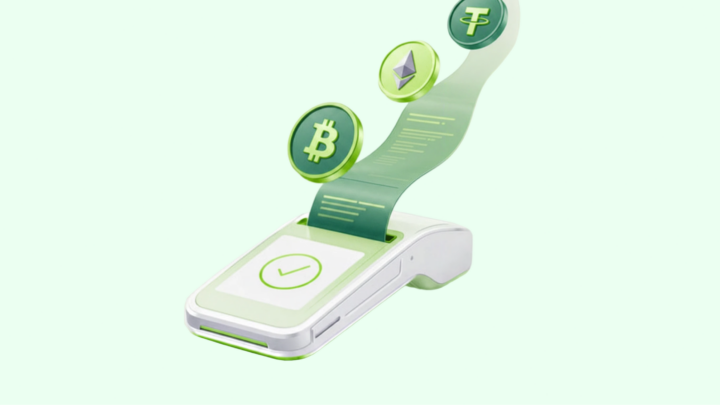
In-Person Outlet: If you run a shop, restaurant, hotel, events or any other in-person business, a physical POS device is shipped to you on request. You enter the amount, the customer scans the QR code or taps an NFC-enabled phone, and the payment is confirmed on the device. Confirmation typically takes about 1 minute.
Which crypto will customers pay with?
Most businesses worry that accepting crypto means exposure to price swings. It doesn’t have to. Stablecoins such as USDT and USDC are pegged to the US dollar, so a payment of 100 USDT is worth about $100 when you receive it and when you withdraw it.
Stablecoins are also where the real volume is. They make up roughly 43% of crypto volume across Sub-Saharan Africa, which is a good indication of what your customers will actually use.
A gateway like Tender supports over 300 crypto assets across 20+ blockchains, including Bitcoin, Ethereum, Solana, TRON, and Stellar. You aren’t limited to one coin, and your customers can pay with whatever they already hold.
What it costs
Tender charges 2% per transaction, capped at $100, so the fee on a very large payment stops growing. There is no monthly fee, and a small one-time activation fee applies on only a few chains (for example, $0.50 on TRON and Stellar, and $3.00 on XRPL).
Compare that to what you may be losing today. A card payment that gets charged back costs you the sale, the product or service, and often a dispute fee on top. With a confirmed crypto payment, the sender can’t pull the money back.
Is it legal to accept crypto in Nigeria?
Crypto is actively used in Nigeria, and the regulatory picture has been moving toward clearer rules from the SEC and the Central Bank of Nigeria. Rules are updated from time to time, so it’s worth keeping up with official announcements. In practice, businesses that accept crypto through a gateway do not need to hold their own VASP license, because the gateway handles the processing and compliance side, including KYC and AML checks. This is general information and not legal advice, so speak to a lawyer or accountant about your own situation.
Common mistakes to avoid
- Holding volatile coins by default. If you don’t want price risk, withdraw to naira or hold stablecoins.
- Asking customers to pay on the wrong network. Make sure customers select the network shown in the payment screen. Sending on a different chain can delay or lose a payment.
- Skipping KYC prep. You can’t start collecting payments until verification is complete, so do it before you plan a launch or a busy period.
- Ignoring auto-payout. Set up automatic payout rules so funds move to your bank without manual work each time.
Frequently asked questions
Do I need to understand crypto to accept it? No. The customer pays in crypto and you receive naira. The gateway generates the address, tracks the payment, and handles the conversion.
Can I accept crypto payments without a website? Yes. Social sellers can collect payments through WhatsApp, and physical stores can use a POS device.
How long does it take to get paid? Once a payment is confirmed it lands in your wallet instantly, and you choose when to withdraw to your bank. Blockchain confirmation time itself ranges from about a minute to two hours depending on the network.
Can a customer reverse a crypto payment? No. Once a crypto transaction is confirmed on the blockchain, the sender cannot reverse it, which is why chargeback fraud doesn’t apply.
What currencies can I be settled in? Nigerian naira, US dollars, British pounds, and more, with 16+ local currencies supported.
What does it cost? 2% per transaction, capped at $100.
Start accepting crypto payments in Nigeria
Accepting crypto in Nigeria comes down to signing up, completing KYC, setting up an Outlet that matches how you sell, and getting paid in naira. If you’ve been losing sales to payment friction or chargebacks, it’s a straightforward fix.
Create your Tender account and start accepting crypto payments today.